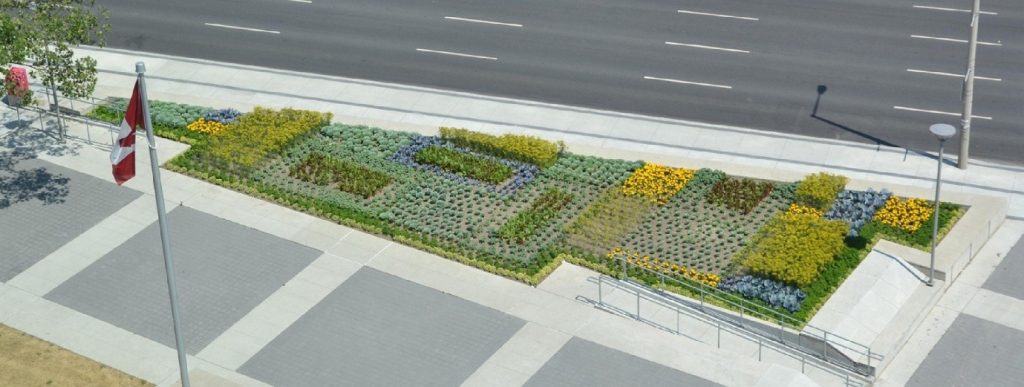
Urban agriculture is often imagined as something contained: a community garden behind a fence, raised beds on a rooftop, or a small urban farm tucked into leftover land. While these spaces are important, they also reflect a deeper assumption: that food production does not truly belong in the everyday fabric of the city.
But what if it did?
What if streets, parks, schoolyards, and public plazas were not only spaces of movement and leisure, but also places that produce food? This is where the idea of edible urban landscapes begins; not as a replacement for urban agriculture, but as its natural evolution.
What Is an Edible Urban Landscape?
An edible urban landscape integrates food-producing plants (fruit trees, herbs, vegetables, nut trees) directly into the design of public and semi-public spaces. Unlike traditional urban agriculture, which often requires designated plots and active cultivation, edible landscapes blur the boundary between:
- agriculture and landscape architecture
- infrastructure and ecology
- public space and food systems
In this model, food is no longer confined to “agricultural zones.” It becomes part of the city’s green infrastructure.
From Decoration to Productivity
For decades, urban greenery has been judged primarily on aesthetics: neat lawns, ornamental trees, controlled vegetation. Productivity (especially food production) has often been seen as incompatible with urban order. Edible landscapes challenge this logic.
A fruit tree provides shade, improves microclimate, sequesters carbon, supports biodiversity, and produces food. The difference between it and an ornamental tree is not ecological, but cultural.
The question is no longer “Can cities grow food?”. It is “Why do we insist that they shouldn’t?”.
Design, Maintenance, and the Fear of “Messiness”
One of the strongest objections to edible landscapes is the perception of disorder: Fallen fruit, seasonal changes, uneven growth patterns. Yet cities already manage leaf fall, pollen, bird droppings, and storm debris. Food-producing plants are not inherently more problematic, they simply require a different maintenance mindset.
Well-designed edible landscapes:
- Match species to location and climate
- Use perennial plants with predictable cycles
- Integrate maintenance into existing municipal routines
- Accept a degree of natural variation rather than fighting it
In doing so, they push cities toward a more ecological understanding of order, rather than a purely visual one.
Social Meaning: Who Is the City For?
Edible urban landscapes also raise deeper social questions.
When food grows in public space:
- Who can harvest it?
- Who maintains it?
- Who decides what is planted?
These questions reveal that food is not just a biological need, but a political and cultural resource. Edible landscapes can either reinforce inequality or quietly challenge it, depending on how they are planned and governed.
In the best cases, they:
- Encourage shared responsibility
- Create informal social interactions
- Reconnect urban residents with seasonal cycles
- Restore a sense of collective ownership over public space
A Shift in How We Imagine Cities
At its core, the idea of edible urban landscapes asks us to rethink the role of cities altogether.
Instead of:
Cities as places that consume resources brought from elsewhere
We begin to imagine:
Cities as systems that produce, recycle, and sustain parts of their own needs
This does not mean cities will become self-sufficient farms. Rather, it means acknowledging that food, like water and energy, is part of urban metabolism.
Closing Reflection
Edible urban landscapes are not a utopian fantasy. They already exist (quietly) in streets, courtyards, campuses, and informal spaces around the world. What is missing is not knowledge, but permission: cultural, institutional, and psychological.
Perhaps the real question is not whether cities can grow food, but whether we are ready to let them.
Leave a Reply